2018年7月26日星期四

Blood Test to Suggest Best Possible Treatment for Advanced Prostate Cancer

"/
Lawson Health Research Institute, Memorial Sloan Kettering Cancer Center, the Royal Marsden and Epic Sciences conducted an international mutual study which discovered a novel blood test that can foresee advanced prostate cancer patient response to particular treatments, resulting in better survival.
A liquid biopsy test introduced by molecular diagnostics company Epic Sciences was used, that evaluates circulating tumor cells (CTCs) in blood collected from patients suffering from advanced prostate cancer who are contemplating a shift from hormone-targeting therapy to chemotherapy. CTCs are cancer cells that depart from a tumor and flow into the bloodstream and penetrate other parts of the body, causing metastasis.
The test looks for a protein called AR-V7 in the cell nucleus of the patient's CTCs. The research team aspired to conclude whether the existence of this protein predicted which treatment would result in maximum prolongation of a patient's life. They discovered that patients who tested positive for the protein gave the best response to taxane-based chemotherapy whereas, those who tested negative responded best to hormone-targeting therapy with androgen-receptor signaling (ARS) inhibitors, the two most commonly used drug classes to manage advanced prostate cancer.
"The study focused on a critical decision point when patients and their oncologists are choosing what therapy to pursue next," says Dr. Alison Allan, a scientist at Lawson and Chair, Department of Anatomy & Cell Biology at Western University's Schulich School of Medicine & Dentistry. "We are addressing a critical unmet need by validating that a blood test or liquid biopsy can be used to select a therapy most likely to extend a patient's life."
from Drugdu  https://goo.gl/QgQoHk

2018年7月18日星期三

Hidden Blood in Stool Could Predict Fatal Health Conditions

If a drop of blood is seen in stool, people tend to panic. The causative factors could include digestive, respiratory, circulatory, hematological or even neuropsychological diseases.
A fecal occult blood test detects unseen blood in feces that leads to the screening of colon cancer. But a positive test could also leads to other serious issues.
Dr. Robert Steele, the lead author and Professor of Surgery from the University of Dundee Ninewells Hospital and Medical School said, "People with traces of blood in their bowel as picked up by the bowel screening test are at a 58 percent higher risk of premature death from a variety of causes—not just bowel cancer."
Steele claimed that inflammation might even lead to bleeding in the bowel, Alzheimer’s disease and other types of cancers. Dr. Marc Siegel, a clinical professor of medicine from NYU Langone Medical Center in New York said, "Inflammation is related to excess weight, insulin resistance, lack of exercise and poor diet."
A healthier lifestyle or proper treatment for the associated medical conditions would result in positive health benefits even if the bowel screening test is positive. But one should keep in mind that the chance of death for people with blood in their stool is nearly 8 times comparatively.
Dr. Uri Ladabaum, the professor of medicine from Stanford University School of Medicine in California, said"Testing for hidden blood in the stool can find early colorectal cancer or pre-cancer, leading to decreased risk of colorectal cancer death; I don't think that colorectal cancer screening programs should be tasked with dealing with all the possible non-colorectal cancer risks that might be signaled by hidden blood in the stool.”

from Drugdu  https://goo.gl/QgQoHk

2018年7月16日星期一

Novel Blood Test to Predict TB


More than ten million people have been diagnosed with tuberculosis, among which 2 million people die worldwide. Therefore, the highly pathogenic disease named tuberculosis was considered as the leading cause of death throughout the world. In the same way that finding a single stop therapeutic solution for tuberculosis is highly challenging, even predicting its onset in advance seems to be equally perplexing.
But the research team led by Dr. Gerhard Walzl from Stellenbosch University in South Africa has discovered a new blood test to predict tuberculosis development up to two years before its onset in high-risk patients. In the study, the expression level of four genes named “RISK4”, associated with inflammatory response, were measured. This novel test could also predict tuberculosis condition without putting a large number of lower-risk people through unnecessary prevention therapy.
“An individual component of this signature may not be sufficient to deliver an accurate diagnosis of prediction, but a combination of these markers improves its accuracy," Dr. Gerhard Walzl said. He further added, "We are hoping that primary health clinics will be able to use such a test and the reagents would then be readily available in that format, similar to the tests that are currently used to diagnose TB."
The post Novel Blood Test to Predict TB appeared first on Drugdu.com
from Drugdu  https://goo.gl/QgQoHk

Blood Transfer to Reverse Ageing

It might sound crazy; but yes. It’s possible to reverse aging by transfusing the blood of teenagers into older adults. Though this idea seems to be haunting everyone’s mind, it finally got implemented by a startup company named Ambrosia in California. Ambrosia conducted human trials, where every 1.5 liters young plasma transfusion would cost around $8000 to the participants. This human trial was completed on Jan 15, 2018, with noteworthy results.
Anti-aging studies are still going on worldwide, in spite of having lots of good and bad consequences. During the 1950’s, scientists proved that the organs of older mice became healthier, by injecting them with younger blood. The scientists also found that aging was connected to only body and it’s ultimately the blood which directs aging.
Tony Wyss-Coray from Stanford University criticized the study of Ambrosia since they charged the participants. Keeping that in mind, he led the anti-aging study in 2014 with his company Alkahest to detect the effect of young blood on Alzheimer patients free of cost. In the U.S. alone, the anti-aging industry is worth around $250 billion and hence it is sure that many private businesses would surely show their interest in this research.
The post Blood Transfer to Reverse Ageing appeared first on Drugdu.com
from Drugdu  https://goo.gl/QgQoHk

Stored Blood May Be Unsafe

A team of scientists from the Alabama University has discovered that blood stored for longer durations may be less safe for patients suffering from severe blood loss and shock.


In the cases of severely injured patients with excessive bleeding, the need of the hour would be a blood transfusion. But if older stored blood were to be used, it could lead to life-threatening symptoms such as pneumonia, dysfunction in blood flow, and an increased inflammation in organs. The research team found a link between older stored blood transfusion and subsequent bacterial pneumonia.
Stored blood transfusion releases the inflammation mediator HMGB1, which is a part of the body's immune response.
Heme is a part of hemoglobin pigment, which gives red blood cells their red color. Heme could be safe in red blood cells but when heme is freed from a globin component, it becomes toxic and leads to tissue injury.
When the blood is stored for a long duration, the red blood cells release free heme during transfusion. Free heme releases the inflammation mediator HMGB1, a part of the body's immune response, induces inflammation and causing sepsis in major organs of the body. This condition may even lead to sudden death.
Rakesh Patel from the University of Alabama at Birmingham in the US said, "An adverse role for heme suggests that finding ways to limit heme exposure or prevent heme toxicity may improve the safety of stored red blood cell transfusions." 
The post Stored Blood May Be Unsafe appeared first on Drugdu.com
from Drugdu  https://goo.gl/QgQoHk

Blood Test to Predict Drug Activity Against Breast Cancer

Scientists from MRC discovered a blood test to detect whether a patient was reacting to the breast cancer drug palbociclib.
At present, breast cancer patients need to wait for nearly two to three months to find out via a scan whether palbociclib is working. This new test could detect the circulating tumor DNA which enters the bloodstream. By measuring and comparing PIK3CA levels in a blood test before and 15 post palbociclib therapy, one could predict the effectiveness of the drug.
Professor Nicholas Turner opens, senior author and Professor of Molecular Oncology at The Institute of Cancer Research, London, and Consultant Medical Oncologist at The Royal Marsden NHS Foundation Trust, said “Having an early indication of how likely a treatment is to work might allow us to adapt treatment – switching some patients to an alternative drug that is more likely to benefit them.”
Dr. Nathan Richardson, Head of Molecular and Cellular Medicine at the MRC, also stated “It is exciting to see that using advances in diagnostic techniques, such as genetic tests for circulating tumor DNA, we may be able to more accurately define groups of patients and help us deliver the right treatment to the right patient sooner. This study provides early evidence that might help us understand sooner when a drug is successfully treating breast cancer, and if not, it can be discontinued and better approaches pursued.”

from Drugdu  https://goo.gl/QgQoHk

Smart Stent to Continuously Monitor Blood Flow

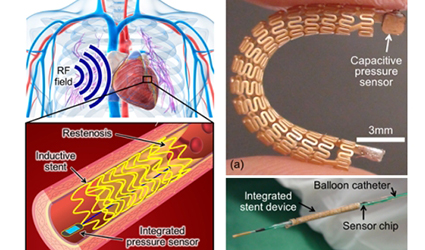
A research team from the University of British Columbia electrical and computer engineering professor Kenichi Takahata has developed a smart stent that monitors elusive changes in artery blood-flow, which can aid in earlier detection and diagnosis making treatment possible. 
Kenichi Takahata said "We modified a stent to function as a miniature antenna and added a special micro-sensor that we developed to continuously track blood flow. The data can then be sent wirelessly to an external reader, providing constantly updated information on the artery's condition".
The smart stent looks similar to most commercial stents and uses medical-grade stainless steel. The researcher remarked that the devices as the first angioplasty smart stent, can be implanted in the patients without any modification in current medical procedures.
“Monitoring the recurrence of abnormal narrowing of an artery after standard stent surgery is critical in maintaining health disease”. “Implanting a smart stent instead of standard stent can assist clinicians in early detection and monitor their patient's health more easily and offer early treatment” stated Research collaborator Dr. York Hsiang, a UBC professor of surgery and a vascular surgeon at Vancouver General Hospital
The device prototype was successfully lab tested in a pig model. The research team is looking at industry partnerships to further advance the device, put it through clinical trials and eventually commercialize it.
from Drugdu  https://goo.gl/QgQoHk